Support the Cause
    Back to Documents
    Sequential ExaminationNovember 13, 2026

    Episode Number 19

    Episode Number 19: GBC Resolution Nos. 1 & 2 (27th February, 1982). It's the GBC's Turn to Become Dīkṣā Gurus — They Were Left Out.

    Srila Prabhupada's Founding Documents & The GBC Resolutions Record (1975–2026)

    A Sequential Examination

    Episode Number 19

    GBC Resolution Nos. 1 & 2 (27th February, 1982)

    It's the GBC's Turn to Become Dīkṣā Gurus — They Were Left Out

    Reading Time : 8 Minutes

    13th November 2026

    "This episode is available in multiple languages at www.justiceforsrilaprabhupadafoundation.com. Use the translate button on the page."

    Where We Are in the Series

    Episodes 19–22 and Supplement 6

    In the next five readings, we move into 1982, where several important changes begin to appear in the GBC resolutions. All are nominated as possible initiating gurus. Then comes the confusion regarding GBC authority.

    The final two episodes, Numbers 21 and 22, will show how the GBC resolutions deal with Śrīla Prabhupāda's "my initiated disciple" clause in his Will.

    Once again, we are doing something very simple: placing what Śrīla Prabhupāda left behind beside what came later, and asking — where is the authority for the difference?

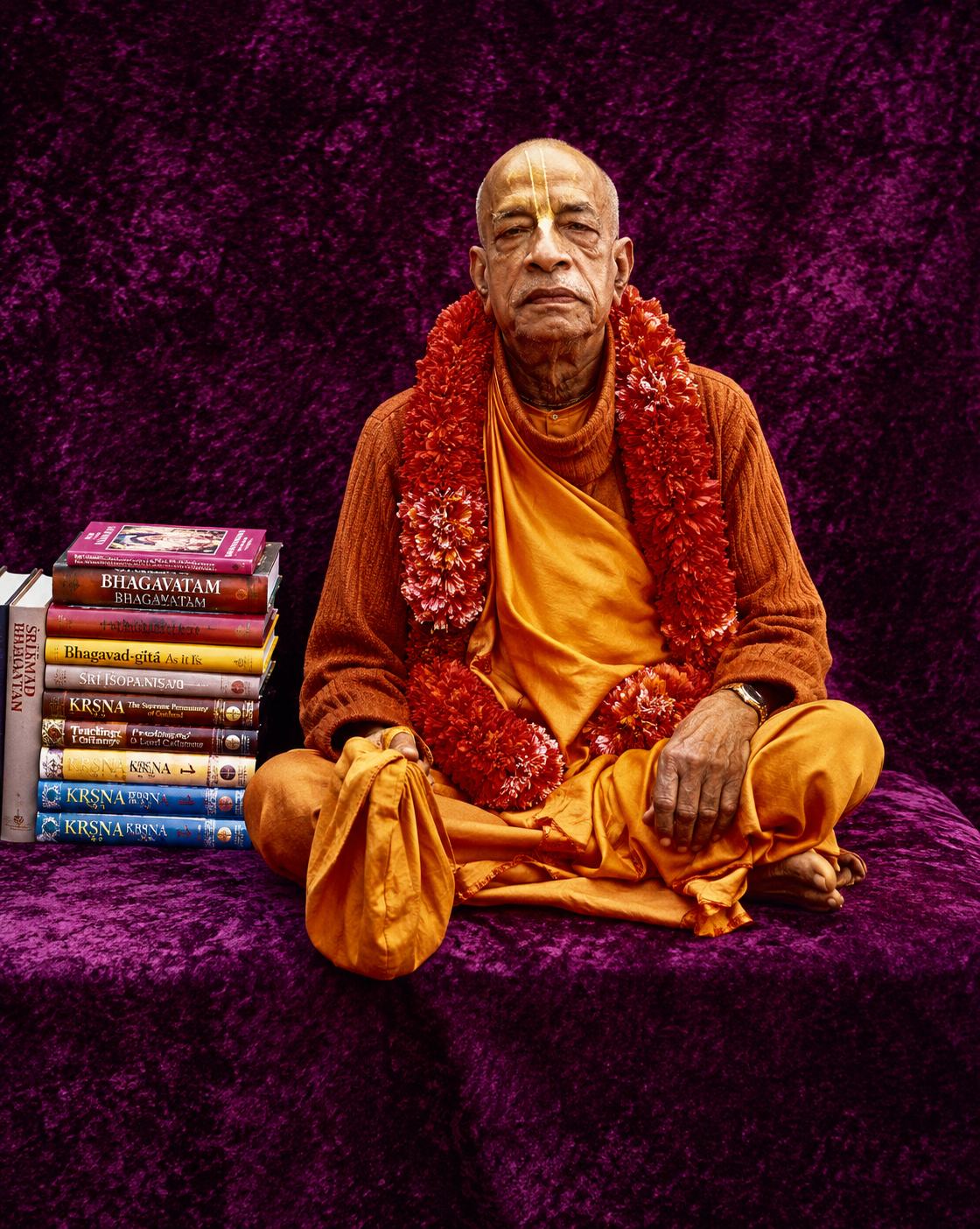
    His Divine Grace A.C. Bhaktivedanta Swami

    Prabhupada — Founder-Acharya of ISKCON

    "It is imperative that a serious person accept a bona fide spiritual master in terms of the śāstric injunctions"

    -Śrī Caitanya-caritāmṛta – Ādi-līlā 1.35 purport

    "Mundane votes have no jurisdiction to elect a Vaiṣṇava ācārya."

    - Sri-Caitanya-caritamrta Madhya 1-220 purport

    The Dīkṣā Guru Manufacturing Resolution — All GBC Nominated as Candidates

    _______________________________________________________________

    GBC Resolution No. 1 (27th February, 1982):

    "That all GBC be nominated as candidates to become initiating Gurus with the requirement that they receive the blessings of 3/4 (three fourths) of the GBC members present to begin their initiating role.

    "There after the individual GBC men who are initiating will be responsible for recommending new candidates for initiating Guru from the godbrothers within their zone. These names must then receive the blessings of 3/4 (three fourths) of the majority of the GBC present at the annual meeting for them to begin their initiating roles."

    "The GBC shall prepare a paper elaborating this proposal."


    GBC Resolution No. 2 (27th February, 1982):

    "The following GBC members will take on the responsibilities of initiating Guru:

    1. His Holiness Pancadravida Swami.

    2. His Holiness Bhakti Swarup Damodar Swami.

    3. His Holiness Gopal Krsna Goswami."

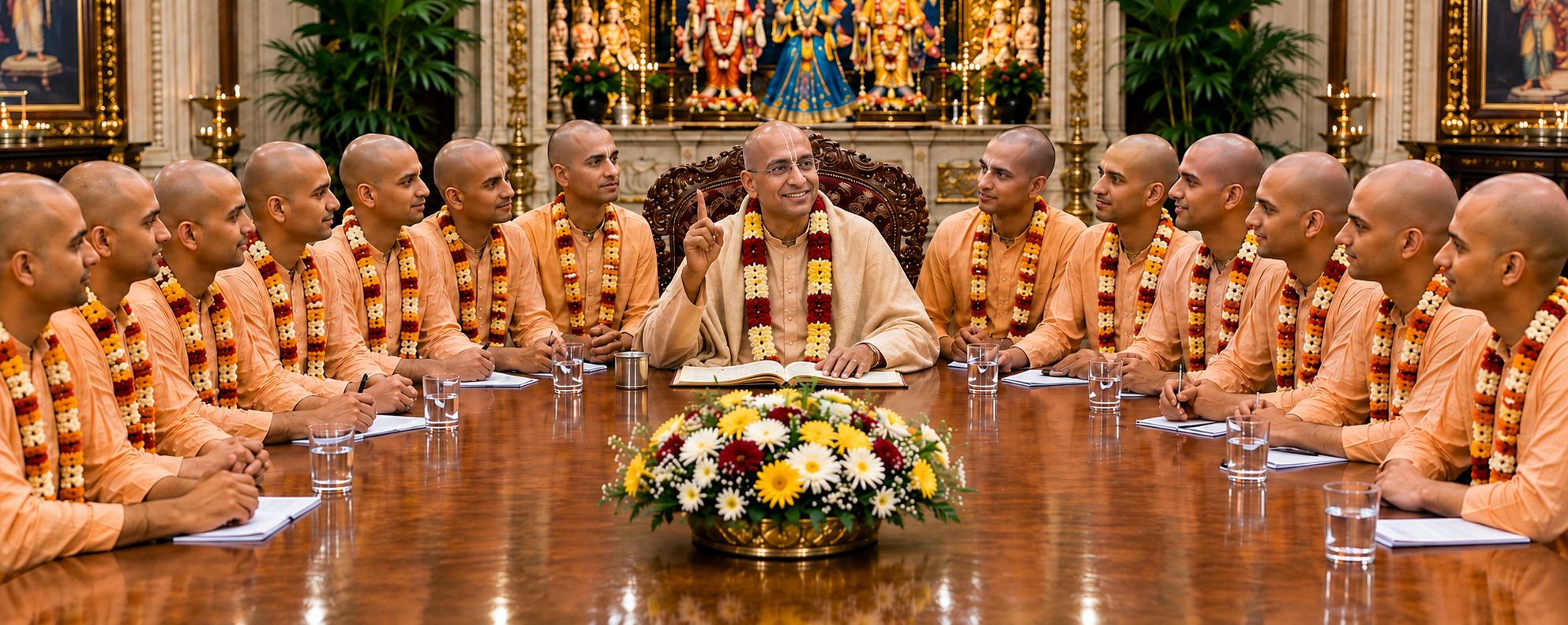
    In 1978, eleven were named. In 1981, the committee of those eleven was formed, given philosophical justification, and granted the power to nominate more. In 1982, the circle widened dramatically.


    All GBC members were now nominated as candidates to become initiating gurus.

    Not chosen by any process Srila Prabhupada described. Not recognised by those who are themselves spiritually advanced. Not named in any founding document. Simply nominated — all of them — as candidates. And confirmed by a 3/4 vote of the GBC body. The same body they were members of.

    The dīkṣā guru manufacturing resolution had arrived. Not with drama. Not with announcement. With a simple procedural motion at the February 1982 meeting.

    They Were Left Out. Now It's Their Turn.

    The 1978 zonal system had named eleven. The GBC had many more members than eleven. Those who were not among the eleven were — by the logic of the system — not initiating gurus. They managed zones. They served on committees. They passed resolutions. But they did not initiate disciples.

    By 1981 the Āchārya Standing Committee had been formed, the philosophical paper on selecting spiritual masters had been distributed, and the committee had been given the power to nominate new gurus. The door was open.


    Resolution 1 of February 1982 walked all GBC members through it at once.

    That all GBC be nominated as candidates. Not one by one. Not after demonstrated spiritual qualification. Not after years of recognised surrender. All. As a category. By virtue of holding the GBC position.

    The GBC position was not a spiritual qualification in any founding document. The Direction of Management described it as a management function. The Final Order Letter described the eleven as officiating representatives. Neither document connected GBC membership to dīkṣā authority.

    In 1982, that connection was made by resolution. The institution had spiritually damaged itself. Partially.

    THE PROGRESSION — FROM ELEVEN TO ALL

    Five years. From eleven named by the Founder-Acharya to all GBC eligible by resolution. The Founder named eleven. The institution nominated everyone.

    A Committee Cannot Produce a Saint.

    The Vaiṣṇava tradition is unambiguous on this point. A guru is not appointed. He is not elected. He is not nominated by his peers and confirmed by a 3/4 vote of a governing body.

    A guru is recognised. By those who are themselves spiritually advanced. By the evidence of his life, his surrender, his realisation, his transmission. Recognition is not a procedural act. It is a spiritual one.

    A 3/4 vote of the GBC cannot produce a saint. It can only produce a candidate.

    The resolution itself acknowledges this gap — without meaning to. It says the GBC shall prepare a paper elaborating this proposal. A paper elaborating a proposal to nominate all GBC as guru candidates. The philosophical justification was to follow the institutional decision.

    In every tradition of genuine spiritual lineage, the realisation precedes the role. In ISKCON's 1982 resolution, the role preceded the paper that would justify it.

    The cart was placed before the horse. The institution before the qualification. The vote before the recognition.

    Question 1  ·  Who Nominates a Diksha Guru?

    Resolution 1 of February 27, 1982 describes a system in which:

    GBC members nominate themselves as guru candidates.

    GBC gurus then nominate their godbrothers as guru candidates.

    The full GBC body votes by three-quarters majority.

    In the Brahma-Madhva-Gaudiya parampara, the question of who becomes a diksha guru has been addressed consistently across thirty-two links:

    The guru authorises the disciple. The disciple acts on the guru's instruction and the strength of his own realisation.

    In the parampara record: not one of the thirty-two acharyas was nominated by a management committee and approved by a three-quarters vote.

    Sri Chaitanya Mahaprabhu said: amar ajnaya guru hana — by My order, become a guru. The operative word is order. Ajnaya. Examined in a later Episode of this series.

    The 1982 resolution describes a different mechanism. The GBC nominates. The GBC votes. The guru is approved.

    The parampara has a mechanism. The 1982 resolution has a different mechanism. Both are in the record.

    Question 2  ·  Why Expand the Numbers?

    Resolution 1 of February 27, 1982 opens the initiation role to all GBC members simultaneously. It then allows those GBC gurus to recommend their godbrothers. The circle of initiating gurus was designed to grow.

    The 1982 resolution does not state why expansion was needed. It does not cite a shortage. It does not cite demand from the devotee community.

    The founding document that would have provided the basis for expanding the number of diksha gurus — does not exist.

    Sri Chaitanya Mahaprabhu's instruction is: by My order, become a guru. The 1982 resolution describes a different mechanism for becoming a guru.

    Question 3  ·  The Parampara Question

    The GBC's own Sastric Advisory Council acknowledged in 2012:

    "Our present system has institutionalized a process of senior devotees voting or offering no-objection to prospective gurus.  But we do not find that this institutionalized blessing-seeking process is mentioned by guru, sadhu or sastra as the way that one is authorized to become a guru."

    — The Sastric Advisory Committee (SAC) paper titled Balancing the roles of the GBC and the disciple in Guru selection - July 3, 2005 - gbc.iskcon.org.

    The GBC's own advisory body confirmed thirty years after Resolution 1 of 1982 that the voting system it introduced has no basis in guru, sadhu or sastra.

    And the GBC's 2014 resolution — examined in a later Episode of this series — described the system as unique in the history of Vaishnavism.

    Unique in the history of Vaishnavism. Not found in guru, sadhu or sastra. These are the GBC's own descriptions of the system introduced in 1982.

    The Final Order Letter, July 9 1977. Approved by A. C. Bhaktivedanta Swami) is also in the history of Vaishnavism. It is not unique. It describes a representative acting on behalf of the principal.

    TWO DEVOTEES OF SRILA PRABHUPADA — THE RECORD SPEAKS

    Strictly documentary

    Mataji

    Prabhuji, Srila Prabhupada's letter of 9 July 1977 was addressed to all GBC and temple presidents. What did Srila Prabhupada call the eleven?

    Prabhuji

    The letter says "'rittik'-representative of the acarya, for the purpose of performing initiations."

    Mataji

    And whose disciples were the new devotees to be?

    Prabhuji

    The letter says the newly initiated devotees are disciples of His Divine Grace A.C. Bhaktivedanta Swami Prabhupada.

    Mataji

    Now, in February 1982, Resolution 1 opens the door for all GBC to become initiating Gurus. Does it say whose disciples their initiates will be?

    Prabhuji

    It does not say.

    First Disciple

    And who chooses the next gurus after that?

    Prabhuji

    The resolution says the GBC men who are initiating will recommend new candidates "from the godbrothers within their zone."

    First Disciple

    Within their zone? Is the word zone in the July 9th Letter?

    Prabhuji

    The letter names eleven representatives. It does not give anyone a zone.

    Mataji

    Then who gives the final blessing?

    Prabhuji

    "3/4 (three fourths) of the majority of the GBC present at the annual meeting."

    Mataji

    Prabhu, did our Guru Maharaja ever give the GBC a vote over who becomes guru?

    Prabhuji

    The founding documents do not say so.

    Mataji

    Then where is the authority for the difference?

    Prabhuji

    The record does not say.

    ✦ Devotee reflection ✦

    The Keys

    The GBC concluded that the keys left in the founding documents were no longer sufficient.

    Instead of using those keys, they chose to open another safe—one in which they themselves held the keys.

    Sometimes, the location of the keys tells the story better than the reason they were changed.

    ✦ ISKCON DevoteeS reflection ✦

    Śrīla Prabhupāda established a permanent representative system.

    Later, the GBC adopted the selection of dīkṣā-gurus through nomination and voting.

    If there is no apparent clear reference for either system in guru, sādhu and śāstra, which one should we follow?

    One was established by Śrīla Prabhupāda.

    The other was adopted later by the GBC.

    That is the test.

    ✦ DID YOU KNOW? ✦

    Disciplic succession means the succession of disciplic conclusions - not, necessarily, the filling of the posts.

    This work is sequential, not selective. It does not examine every GBC resolution. Rather, it examines every resolution, statement, or policy that conflicts with, departs from, or contravenes Śrīla Prabhupāda's founding documents and direct instructions.

    ACCESS THE ARCHIVES

    Explore Srila Prabhupada's original founding documents and the complete GBC Resolutions Record (1975–2026), now available in our public Google Drive archive — free to access, download, and share.

    Help us spread awareness by forwarding this email to fellow devotees and supporters.

    "This episode is available in multiple languages at

    www.justiceforsrilaprabhupadafoundation.com

    use the translate button on the page."

    Coming Next

    Episode No. 20 (7 min read)

    Who Is the Ultimate Authority?

    16th November 2026 · 6:00 PM IST

    Subscribe to ensure you receive every episode directly in your inbox.

    Copyright © 2026 Justice For Srila Prabhupada Foundation, All rights reserved.
    Our e-mail address is:
    justiceforsrilaprabhupada@gmail.com
    Want to change how you receive these emails?
    You can
    unsubscribe from this list or Manage your preference.

    Disclaimer — Use of the Term "Resolution"

    For the purposes of this work, the term "resolution" or "resolutions" is used as a collective reference and, where applicable, includes statements, action orders, provisional orders, amendments, and other decisions or recorded actions appearing in the GBC records.

    The use of the term "resolution" should therefore not be understood as altering or replacing the original classification or designation given to any particular item in the GBC records.

    Disclaimer and Statement of Independence

    This publication is prepared and presented solely for informational, educational, research and public-discussion purposes. It examines historical and institutional documents, including Srila Prabhupada's founding documents, publicly available GBC resolutions, statements and ISKCON laws, and considers the relationship between those documents and the authority exercised thereunder.

    Unless otherwise indicated, quotations from GBC resolutions, statements and ISKCON laws are reproduced from publicly available records and are intended to be quoted accurately and in their original context. Founding documents and other historical materials referred to herein have been reproduced or cited from publicly available primary or archival sources. Readers are encouraged to consult the original documents and sources themselves.

    The analysis and conclusions expressed in this publication are those of the authors/Foundation and are presented for discussion, research and educational purposes. They do not purport to constitute legal advice, a judicial determination, or a statement of binding legal or doctrinal authority. References to legal principles, doctrines or authorities are intended to explain the analytical framework adopted in this publication and should not be understood as representing that any particular legal conclusion has been finally adjudicated by a competent court or other authority.

    Where this publication expresses an interpretation, inference, criticism or opinion concerning institutional governance, authority or historical events, such statements are intended as good-faith analysis based upon the documents and materials identified or cited herein. Any distinction between documented fact, inference, interpretation and opinion is intended to be maintained throughout the publication.

    The Justice for Srila Prabhupada Foundation ("JFSPF" or the "Foundation") is an independent organization. It is not affiliated with, controlled by, endorsed by, authorized by, or representative of ISKCON, the Governing Body Commission ("GBC"), or any ISKCON-affiliated or associated entity, unless expressly stated otherwise.

    The Foundation does not represent that the GBC resolutions record, ISKCON archival material, or any other historical record examined for this publication is complete or exhaustive. The absence of a document from the sources examined should not be construed as proof that no such document exists. Readers are therefore encouraged to consult the underlying primary sources and any additional relevant materials.

    Nothing in this publication is intended to attribute a statement, position, motive, act or omission to any individual or organization beyond what is supported by the sources identified. Where the publication discusses disputed matters, competing interpretations or allegations, those matters are intended to be understood in that context and not as findings of a court or other competent authority.

    The publication is not intended to suggest that JFSPF speaks for Srila Prabhupada, his successors, ISKCON, the GBC, or any other individual or institution, nor is it intended to interfere with or determine any person's legal rights or remedies.

    All rights concerning third-party materials remain with their respective owners. Where third-party material is reproduced, quoted or referred to, such use is intended to be limited to the purposes of research, criticism, review, scholarship, education, reporting or discussion, as applicable under law. The inclusion of such material does not imply ownership of that material by JFSPF.

    The Foundation reserves the right to correct, clarify or update this publication if additional authentic primary-source material becomes available or if any factual error is identified.
    Powered by Google TranslateTranslate
    Original text
    Rate this translation
    Your feedback will be used to help improve Google Translate