Support the Cause
    Back to Documents
    Sequential ExaminationNovember 18, 2026

    Episode Number 21

    Episode Number 21: GBC Resolution No. 2 (25th February, 1980) & GBC Resolution Nos. 7 (1st March, 1982). Making Laws Outside the Chambers.

    Srila Prabhupada's Founding Documents & The GBC Resolutions Record (1975–2026)

    A Sequential Examination


    Episode Number 21

    GBC Resolution No. 2 (25th February, 1980) & GBC Resolution Nos. 7 (1st March, 1982)

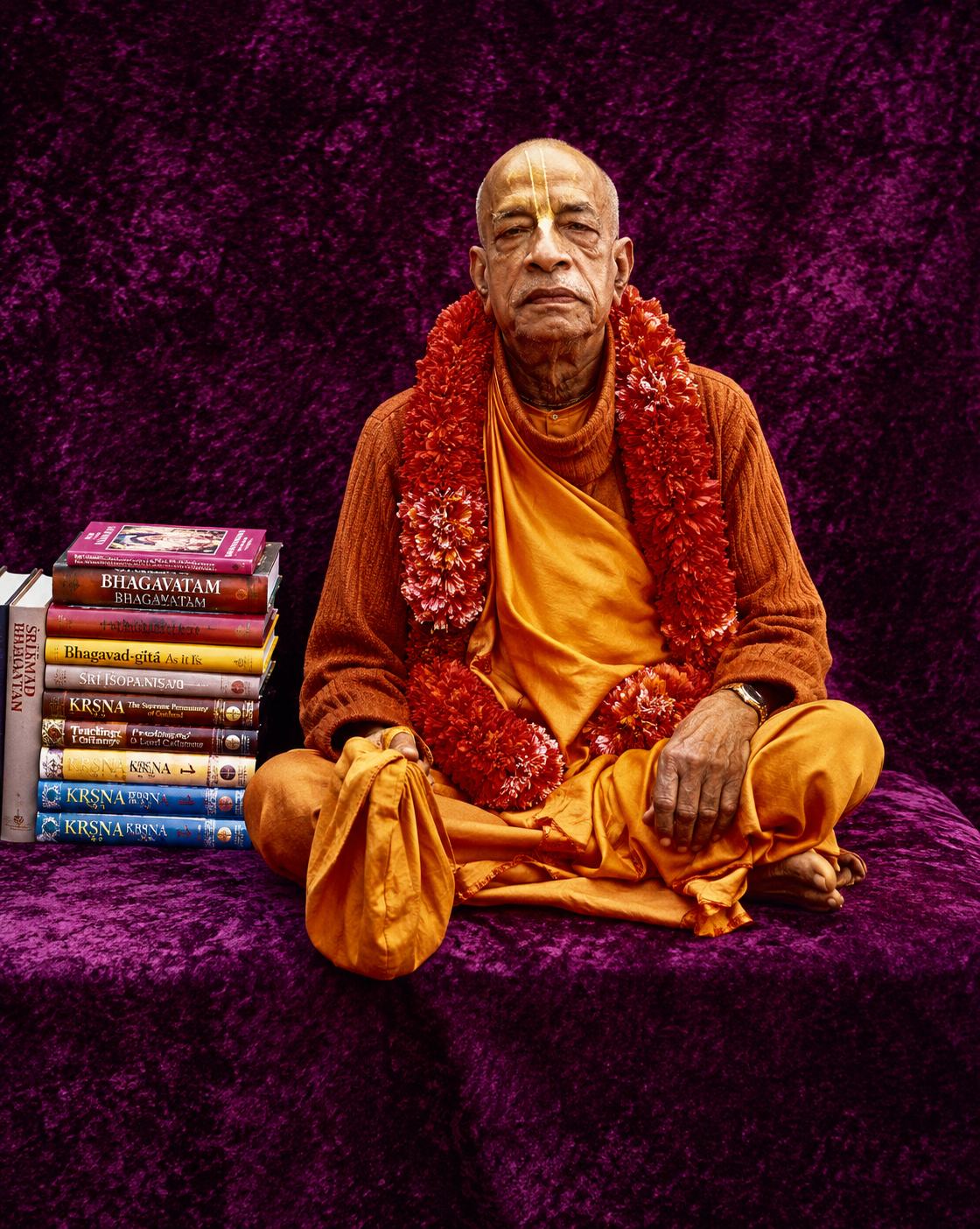
    His Divine Grace A.C. Bhaktivedanta Swami

    Prabhupada — Founder-Acharya of ISKCON

    "The executive directors who have herein been designated are appointed for life. In the event of death or failure to act for any reason of any of the said directors, a successor director or directors may be appointed by the remaining directors, provided the new director is my initiated disciple following strictly all the rules and regulations of the International Society for Krishna Consciousness as detailed in my books, and provided that there are never less than three (3) or more than five (5) executive directors acting at one time"

    — Srila Prabhupada's Last Will and Testament, June 6 1977

    "There shall be a Governing Board Committee of trustees appointed by the Founder-Acharya His Divine Grace A. C. Bhaktivedanta Swami Prabhupada according to the document Direction of Management dated July 28, 1970. The GBC is to act as the instrument for the execution of the will of His Divine Grace Srila Prabhupada."

    — Topmost Urgency, July 22 1974

    GBC Resolution No. 2 – Old Business (25th February, 1980):

    2(1): "That within three months all ISKCON owned properties will be properly registered as per Srila Prabhupada's will. Srila Bhagavan Goswami will personally follow this up by calling the GBC members by phone after three months, if written reports have not been received in New Mayapur, France by that time."

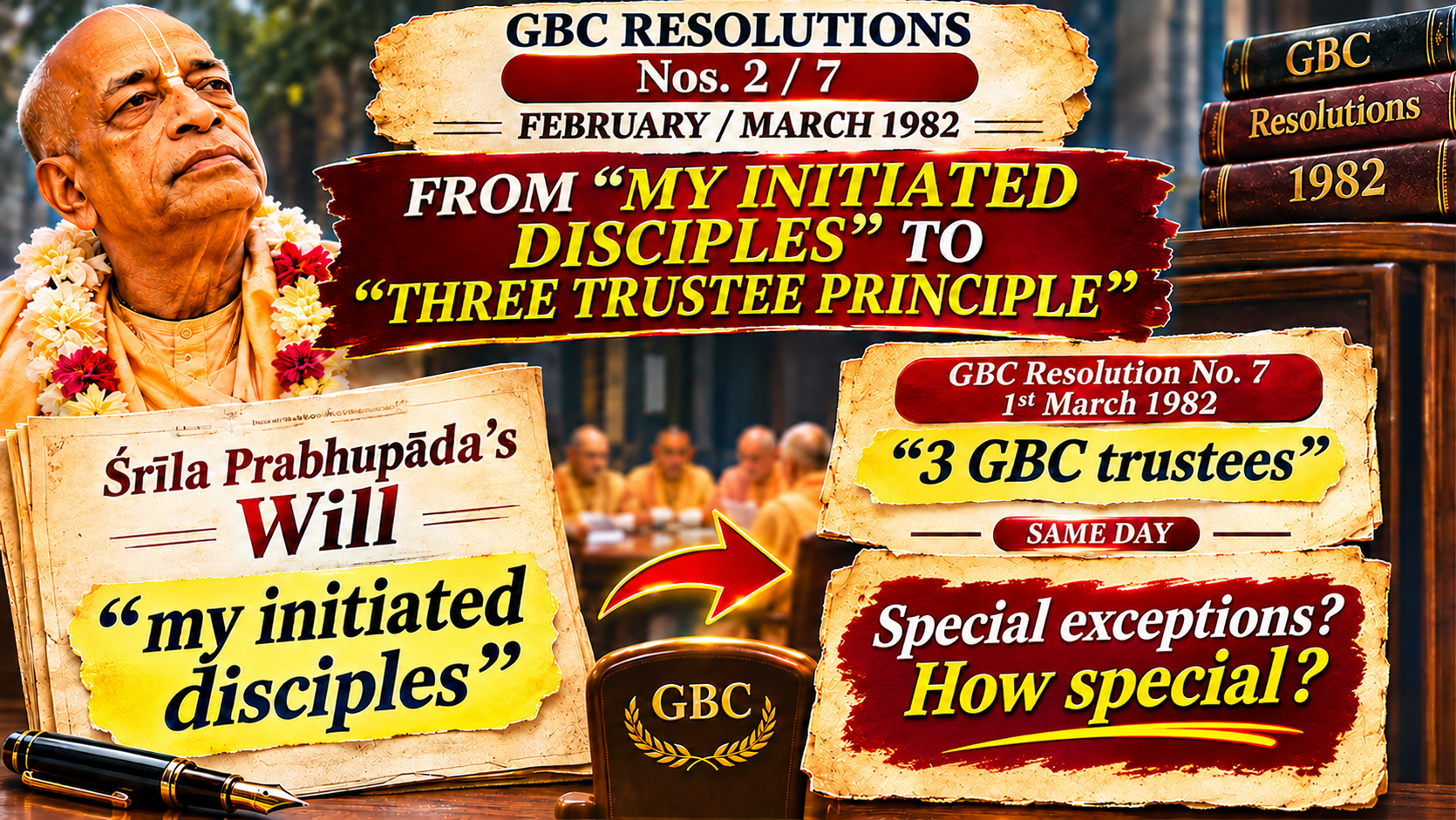
    GBC Resolution No. 7 (1st March, 1982):

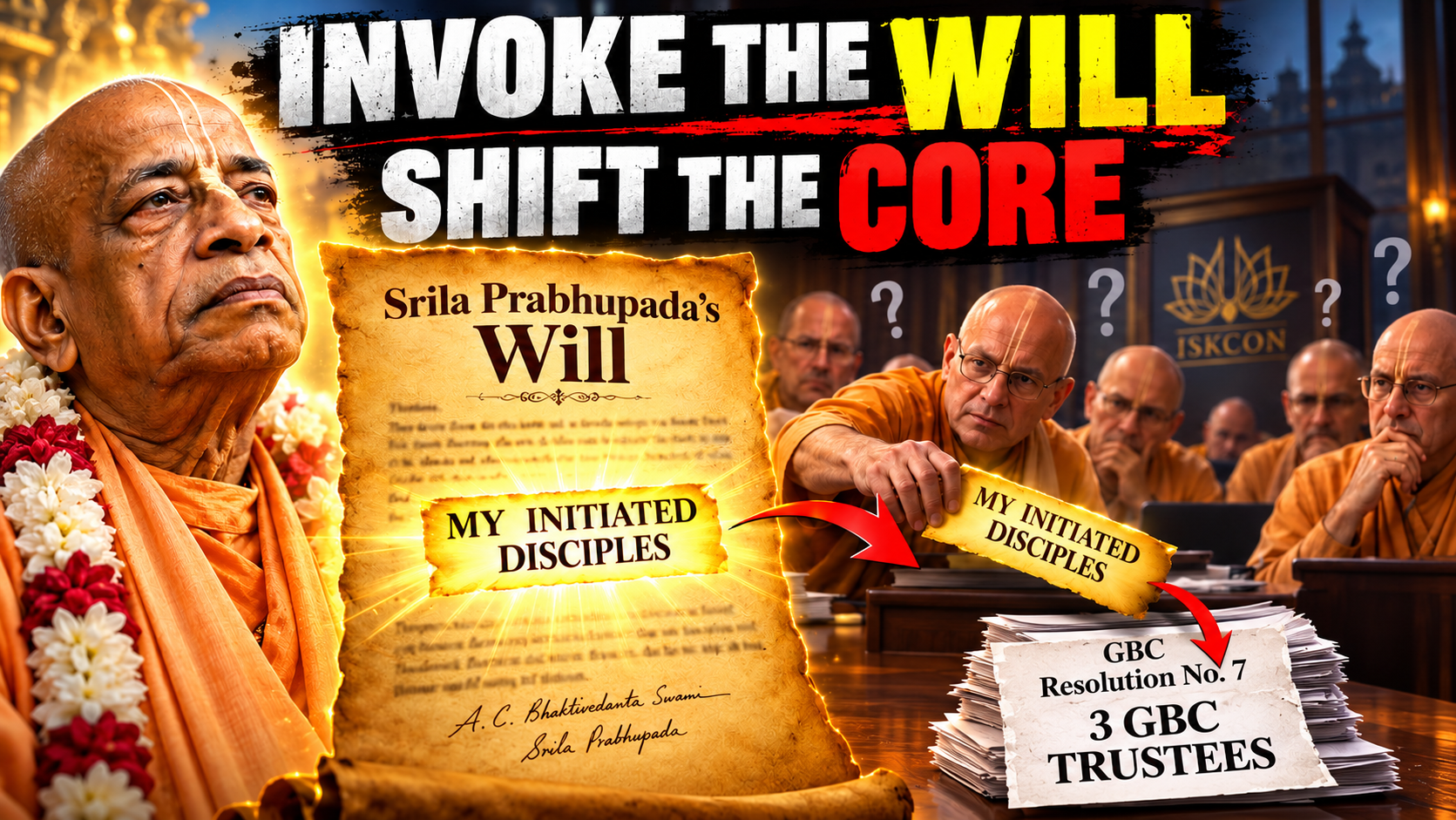
    "That GBC members who have not transferred control of the sale or mortgage of all ISKCON properties to the 3 GBC trustees as per Srila Prabhupada's last will, by next year's meeting (1983) will be reduced to the status of acting GBC, until such time as the transfer is completed."


    "If this is still not done by the following year (1984) then he will be asked to resign from the GBC body."

    "Special exceptions can be made with approval of the legal committee."

    Let us follow the deadline. It is the most honest thing to follow.

    February 1980: Resolution 1 orders all ISKCON properties to be registered as per Srila Prabhupada's Will within three months. By May 1980. Srila Bhagavan Goswami will personally call GBC members to follow up.

    March 1982: Two years later. The properties have not been transferred. A new resolution is passed. GBC members who have not complied will be reduced to acting GBC status — if they still have not complied by the 1983 annual meeting.


    The three-month deadline became a two-year delay. The two-year delay became a one-year extension. And the penalty for non-compliance was — a lesser title within the same body.

    Not removal. Not accountability to an external authority. Not reference to Srila Prabhupada's Will and its specific requirements. A temporary reclassification. Acting GBC. Until the transfer is completed. Which — given the trajectory — raises one question above all others.


    A teacher gives the class an assignment. It must be submitted in three months. Three months pass. No submissions. The teacher gives a two-year extension. Two years pass. Still incomplete. The teacher announces: those who have not submitted by next year will receive a slightly different grade — temporarily — until they submit. The class nods. No one submits. And the teacher — who is also a member of the class — awards himself a passing grade for having passed the resolution.


    The Deadline That Kept Moving.

    Three months in 1980. One year extension in 1982. By 1983 — or else. What happened in 1983?

    GBC Resolution 606 of 2002 — twenty years after the 1982 deadline — acknowledged that the Property Trustee system established by Srila Prabhupada in his Will had never previously been fully implemented.


    Three months. Two years. One more year. Twenty years of non-implementation. Forty-five years after Srila Prabhupada signed his Will.

    This is not oversight. This is not administrative delay. This is a pattern — visible in the resolutions, documented in the GBC's own record, and acknowledged by the GBC itself in 2002.

    Each deadline extension is an ultra vires act. The resolution extends what the Will established. The Will did not provide for extensions. The Will named trustees, established conditions, and set irrevocable terms. A resolution cannot extend what a Will has fixed. A resolution cannot grant itself time to comply with a document it was supposed to implement.


    Ultra vires. Anytime. Any resolution that extends the timeline for implementing the Will is outside the authority of those who passed it.


    The Penalty That Was Not a Penalty.

    Resolution 7 provides a consequence for non-compliance: reduction to acting GBC status. Until the transfer is completed.

    Let us examine this consequence carefully.

    Acting GBC status means: attending meetings with GBC meeting attendance rights, zonal administration rights, but no voting rights.

    No voting rights. For a defined period. Until transfer is completed.

    But the transfer — as the 2002 admission confirmed — was never completed for decades. So the acting GBC status would theoretically persist for decades. And yet GBC members continued to vote. Continued to pass resolutions. The voting still continues . It's 2026.


    The penalty existed on paper. Its application is not documented. Its enforcement is not recorded. Its effect on the property transfer is not visible in the resolutions that followed.

    A penalty that is not enforced is not a penalty. It is a resolution. And a resolution that extends a deadline without enforcing consequences is not governance. It is the appearance of governance — which this series has now documented across twenty-seven references.

    DEVOTEE REFLECTION

    THE FUNCTIONAL TREE

    Truth is the spine of bhakti.

    Vivekā (discrimination) is its branches.

    Saṁskāra (impressions that shape us) is its roots.

    ✦ Did You Know? ✦

    But Srila Prabhupada's Will named specific individuals as trustees for specific properties in India — for life. It did not create a category of '3 GBC trustees' for North American temple properties.

    ✦ Did You Know? ✦

    The '3 GBC trustees' framing appeared in ISKCON Law 19 of 1981. It replaced 'my initiated disciple' with 'three persons.' And it was now being treated as if it were the Will's own requirement.

    ✦ Did You Know? ✦

    This is what it means to make laws outside the chambers. The chambers - Prabhupada's founding documents, his direct orders, the institutional framework he established - are where legitimate authority resides. What is being constructed here stands apart from those chambers entirely, built on adjacent ground, in the GBC's own name, by the GBC's own hand.

    This work is sequential, not selective. It does not examine every GBC resolution. Rather, it examines every resolution, statement, or policy that conflicts with, departs from, or contravenes Śrīla Prabhupāda's founding documents and direct instructions.

    ACCESS THE ARCHIVES

    Explore Srila Prabhupada's original founding documents and the complete GBC Resolutions Record (1975–2026), now available in our public Google Drive archive — free to access, download, and share.

    Help us spread awareness by forwarding this email to fellow devotees and supporters.

    "This episode is available in multiple languages at www.justiceforsrilaprabhupadafoundation.com

    use the translate button on the page."

    Coming Next

    Episode No. 22 (6 min read)

    My initiated disciples - or GBC Authorization?

    20th November  2026 · 6:00 PM IST

    Subscribe to ensure you receive every episode directly in your inbox.

    Copyright © 2026 Justice For Srila Prabhupada Foundation, All rights reserved.
    Our e-mail address is:
    justiceforsrilaprabhupada@gmail.com
    Want to change how you receive these emails?
    You can
    unsubscribe from this list or Manage your preference.

    Disclaimer — Use of the Term "Resolution"

    For the purposes of this work, the term "resolution" or "resolutions" is used as a collective reference and, where applicable, includes statements, action orders, provisional orders, amendments, and other decisions or recorded actions appearing in the GBC records.

    The use of the term "resolution" should therefore not be understood as altering or replacing the original classification or designation given to any particular item in the GBC records.

    Disclaimer and Statement of Independence

    This publication is prepared and presented solely for informational, educational, research and public-discussion purposes. It examines historical and institutional documents, including Srila Prabhupada's founding documents, publicly available GBC resolutions, statements and ISKCON laws, and considers the relationship between those documents and the authority exercised thereunder.

    Unless otherwise indicated, quotations from GBC resolutions, statements and ISKCON laws are reproduced from publicly available records and are intended to be quoted accurately and in their original context. Founding documents and other historical materials referred to herein have been reproduced or cited from publicly available primary or archival sources. Readers are encouraged to consult the original documents and sources themselves.

    The analysis and conclusions expressed in this publication are those of the authors/Foundation and are presented for discussion, research and educational purposes. They do not purport to constitute legal advice, a judicial determination, or a statement of binding legal or doctrinal authority. References to legal principles, doctrines or authorities are intended to explain the analytical framework adopted in this publication and should not be understood as representing that any particular legal conclusion has been finally adjudicated by a competent court or other authority.

    Where this publication expresses an interpretation, inference, criticism or opinion concerning institutional governance, authority or historical events, such statements are intended as good-faith analysis based upon the documents and materials identified or cited herein. Any distinction between documented fact, inference, interpretation and opinion is intended to be maintained throughout the publication.

    The Justice for Srila Prabhupada Foundation ("JFSPF" or the "Foundation") is an independent organization. It is not affiliated with, controlled by, endorsed by, authorized by, or representative of ISKCON, the Governing Body Commission ("GBC"), or any ISKCON-affiliated or associated entity, unless expressly stated otherwise.

    The Foundation does not represent that the GBC resolutions record, ISKCON archival material, or any other historical record examined for this publication is complete or exhaustive. The absence of a document from the sources examined should not be construed as proof that no such document exists. Readers are therefore encouraged to consult the underlying primary sources and any additional relevant materials.

    Nothing in this publication is intended to attribute a statement, position, motive, act or omission to any individual or organization beyond what is supported by the sources identified. Where the publication discusses disputed matters, competing interpretations or allegations, those matters are intended to be understood in that context and not as findings of a court or other competent authority.

    The publication is not intended to suggest that JFSPF speaks for Srila Prabhupada, his successors, ISKCON, the GBC, or any other individual or institution, nor is it intended to interfere with or determine any person's legal rights or remedies.

    All rights concerning third-party materials remain with their respective owners. Where third-party material is reproduced, quoted or referred to, such use is intended to be limited to the purposes of research, criticism, review, scholarship, education, reporting or discussion, as applicable under law. The inclusion of such material does not imply ownership of that material by JFSPF.

    The Foundation reserves the right to correct, clarify or update this publication if additional authentic primary-source material becomes available or if any factual error is identified.
    Powered by Google TranslateTranslate
    Original text
    Rate this translation
    Your feedback will be used to help improve Google Translate