Support the Cause
    Back to Documents
    Sequential ExaminationSeptember 27, 2026

    Episode Number 4

    Episode Number 4: GBC Resolution No. 3 , 17 & 23 - March 20–21, 1978. Who Must See — And What?

    Srila Prabhupada's Founding Documents & The GBC Resolutions Record (1975–2026)

    A Sequential Examination

    Episode Number 4

    GBC Resolution No. 3 , 17 & 23 - March 20–21, 1978

    His Divine Grace A.C. Bhaktivedanta Swami

    Prabhupada — Founder-Acharya of ISKCON

    "The Trustees shall collect all proceeds from the sale of my books, that is One Hundred Percent (100%) of all the proceeds from all of the International Society for Krishna Consciousness Temples and divide these proceeds into two funds, one-half (1/2) for the fund known as the Book Fund, and one-half (1/2) for the fund known as the Building Fund.

    The proceeds allocated to the Book Fund shall be used for the following purposes,

    all in the discretion of the Trustees, in whom I have complete confidence:

    Printing and reprinting of books;

    Directing and managing all publicity and distribution of my books;

    Processing all copyrights and legal rights to my books;

    Allocating funds as they see fit to ISKCON Press and directing the operation of the activities of ISKCON Press in the printing and reprinting of said books."

    — Bhaktivedanta Book Trust Agreement, May 29 1972

    "So far my books are concerned, I am setting up a different body of management known as the BHAKTIVEDANTA BOOK TRUST. The trustees of this body are also members of the GBC, but their function is not dependent on the GBC."

    — Direction of Management, July 28 1970

    GBC Resolution No. 3 - 20th March, 1978

    "The GBC supports BTG distribution on an expanded scale. BBT is requested to furnish details regarding how many more can be distributed and how to distribute them."


    MOTIONS IN REGARD TO MAYAPUR PROJECT

    GBC Resolution No. 3 - 20th March, 1978

    "That the committee shall have the following powers, responsibilities and obligations:

    a) To allocate funds without further sanction for the implementation, planning etc…of the Mayapur project from any BBT profits, and any other available sources which are given."

    GBC Resolution No. 17 - 21st March, 1978

    "GBC recommends that BBT provide funds for construction."

    GBC Resolution No. 23 - 21st March, 1978

    "Execution of Prabhupada's will must see that his will is being carried out."

    The Four Resolutions

    In the space of two days — March 20, and 21, 1978 — the GBC passed four resolutions that, when placed side by side, reveal a pattern. Each one is modest in appearance. Together they tell a larger story.


    What the BBT Agreement Actually Says

    The BBT Agreement was signed on May 29, 1972. Srila Prabhupada himself transferred all books and publication rights to the Bhaktivedanta Book Trust. The language of that agreement is unambiguous. 

    From The Bhaktivedanta Book Trust Agreement, May 29 1972

    "This trust shall exist independently of the International Society for Krishna Consciousness and the Trustees' functions and duties stated herein shall be separate and not dependent on the Governing Body Commission of the International Society for Krishna Consciousness."

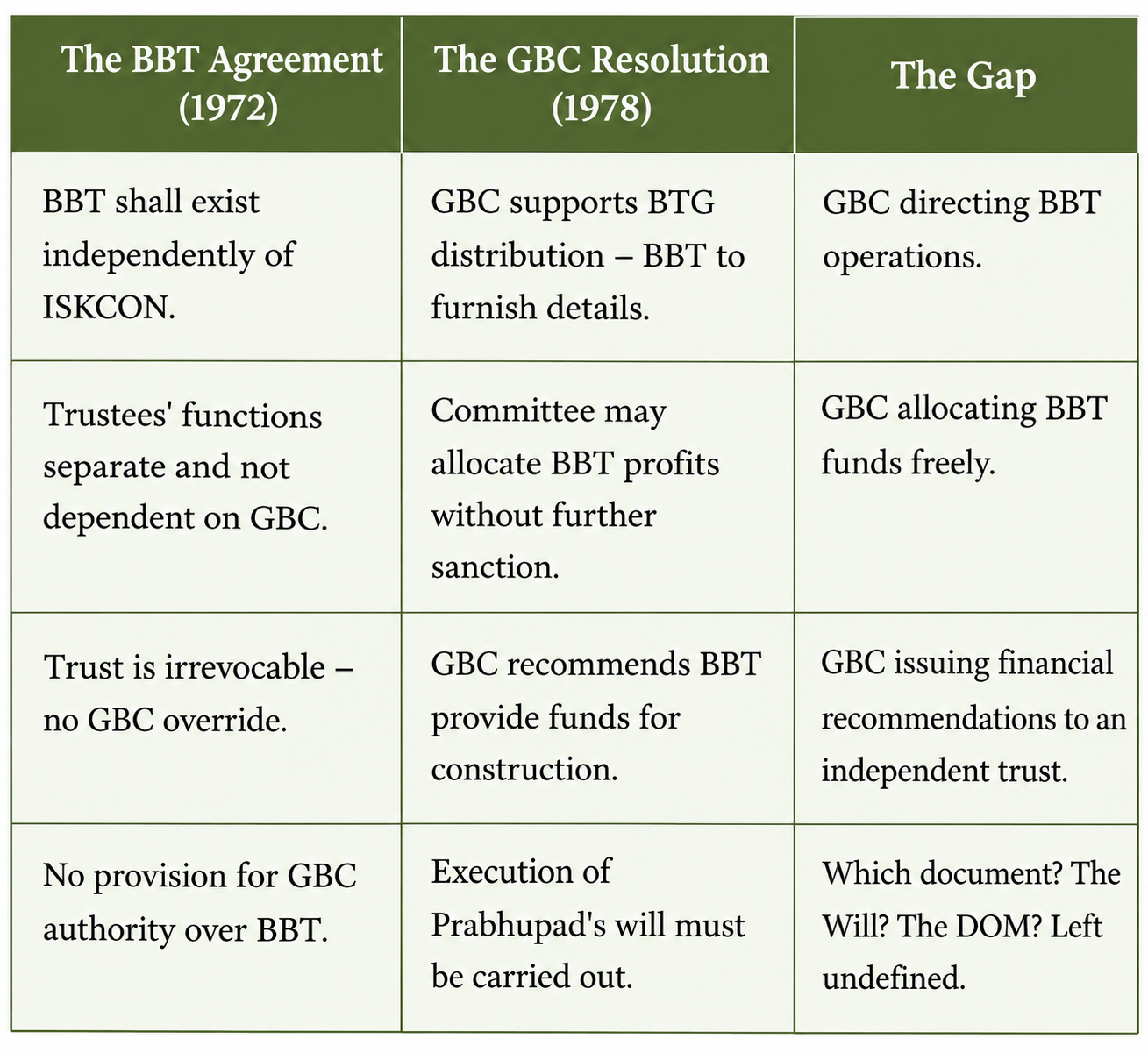
    Six years after that agreement was signed, the GBC is requesting BBT to furnish distribution details, allocating BBT profits to a committee without further sanction, and recommending that BBT provide funds for construction.

    The Three-Word Test asks three questions of every resolution:

    1. What does the founding document say?

    2. What does the resolution say?

    3. Where is the authority for the difference?

    The BBT Agreement answers question one clearly. The resolutions answer question two clearly. Question three — as always — receives no answer in the record.


    Placed Side by Side

     This is not argument. This is placement.

    Resolution 23 — The Deepest Question


    Resolution 23 of March 22, 1978 reads simply: "Execution of Prabhupada's will must see that his will is being carried out."

    On its surface this appears faithful — even dutiful. And in a sense it is. The GBC is acknowledging that Srila Prabhupada left a will and that it must be executed.

    But notice what the resolution does not say.

    It does not name which document it refers to. Srila Prabhupada left multiple signed founding documents: the Direction of Management (1970), the BBT Agreement (1972), the Declaration of Will (June 6, 1977), and the Final Order Letter (July 9, 1977). Each one carries specific instructions. Each one makes specific appointments and restrictions.

    A resolution to execute the will — without specifying which provisions of which document — is a statement of intention without a mechanism of accountability. It sounds complete. It is not complete.

    This is the first appearance in the GBC Resolutions Record of what will become a recurring pattern across five decades: truth — but not the complete truth.


    An Analogy

    A man leaves a detailed estate. He names the trustees of his library. He states clearly that the library is independent of his household management committee and its profits are not to be directed by them.

    After his passing, the management committee passes three resolutions in one week. They ask the library to report on how many books it can distribute. They assign the library's profits to a building project without seeking the trustees' approval. They recommend the library fund construction.

    Then — in the same week — they pass a fourth resolution: "His will must be carried out."

    Which will? The one that gave them authority over the library — or the one that took it away?

    The answer to that question was never given in 1978. It has not been given since.

    Questions and Answers

    Does the BBT Agreement give the GBC authority over BBT profits?

    No. The agreement explicitly states the BBT exists independently of ISKCON and its Trustees' functions are separate and not dependent on the GBC.

    Could the GBC override the BBT Agreement by resolution?

    No. The BBT Agreement was signed by Srila Prabhupad and declared irrevocable. No GBC vote can override a document Srila Prabhupad personally signed.

    What does 'without further sanction' mean in Resolution 3a?

    It means the Mayapur Development Committee could spend BBT profits freely, without needing approval from the BBT Trustees — the very body the BBT Agreement placed in authority over those funds.

    Which document does Resolution 23 refer to when it says 'his will'?

    The resolution does not specify. It could mean the legal Will of June 1977, the Direction of Management, or both. This ambiguity was never resolved in the record.

    Is this the first time the GBC directed BBT funds?

    This is the first clear instance in the Resolutions Record. It will not be the last. The pattern of GBC involvement in BBT affairs grows in subsequent years.

    Were the BBT Trustees consulted before these resolutions were passed?

    The resolutions contain no reference to Trustee consultation, approval, or objection. The record is silent on this point.

    WHICH WILL?

    ✦ Did You Know? ✦

    The BBT Agreement of 1972 names three Trustees appointed for life. Their functions are stated to be independent of the GBC. Yet by March 1978 — just six years after the agreement — the GBC Resolutions Record shows the GBC directing BBT distribution, allocating BBT profits, and recommending BBT fund construction. Not once in any of these resolutions is the BBT Agreement cited, referenced, or acknowledged.

    ✦ Did You Know? ✦

    Resolution 23 is the first time the word "will" appears in the GBC Resolutions Record. It will not be the last. But it will never be accompanied by a clear identification of which document — which specific provisions — are being referred to.

    ✦ Did You Know? ✦

    A resolution passed by the GBC that contradicts Śrīla Prabhupāda's founding documents does not carry greater authority by virtue of being voted upon by more people. Numbers do not elevate authority in spiritual life. Proximity to the source does.

    This work is sequential, not selective. It does not examine every GBC resolution. Rather, it examines every resolution, statement, or policy that conflicts with, departs from, or contravenes Śrīla Prabhupāda's founding documents and direct instructions.

    ACCESS THE ARCHIVES

    Explore Srila Prabhupada's original founding documents and the complete GBC Resolutions Record (1975–2026), now available in our public Google Drive archive — free to access, download, and share.

    Help us spread awareness by forwarding this email to fellow devotees and supporters.

    "This episode is available in multiple languages at www.justiceforsrilaprabhupadafoundation.com

    use the translate button on the page."

    Coming Next

    Episode 5 (9 min read)

    Desire, Desire & Desire

    30th September 2026 · 6:00 PM IST

    Subscribe to ensure you receive every episode directly in your inbox.

    Copyright © 2026 Justice For Srila Prabhupada Foundation, All rights reserved.
    Our e-mail address is:
    justiceforsrilaprabhupada@gmail.com
    Want to change how you receive these emails?
    You can
    unsubscribe from this list or Manage your preference.

    Disclaimer — Use of the Term "Resolution"

    For the purposes of this work, the term "resolution" or "resolutions" is used as a collective reference and, where applicable, includes statements, action orders, provisional orders, amendments, and other decisions or recorded actions appearing in the GBC records.

    The use of the term "resolution" should therefore not be understood as altering or replacing the original classification or designation given to any particular item in the GBC records.

    Disclaimer and Statement of Independence

    This publication is prepared and presented solely for informational, educational, research and public-discussion purposes. It examines historical and institutional documents, including Srila Prabhupada's founding documents, publicly available GBC resolutions, statements and ISKCON laws, and considers the relationship between those documents and the authority exercised thereunder.

    Unless otherwise indicated, quotations from GBC resolutions, statements and ISKCON laws are reproduced from publicly available records and are intended to be quoted accurately and in their original context. Founding documents and other historical materials referred to herein have been reproduced or cited from publicly available primary or archival sources. Readers are encouraged to consult the original documents and sources themselves.

    The analysis and conclusions expressed in this publication are those of the authors/Foundation and are presented for discussion, research and educational purposes. They do not purport to constitute legal advice, a judicial determination, or a statement of binding legal or doctrinal authority. References to legal principles, doctrines or authorities are intended to explain the analytical framework adopted in this publication and should not be understood as representing that any particular legal conclusion has been finally adjudicated by a competent court or other authority.

    Where this publication expresses an interpretation, inference, criticism or opinion concerning institutional governance, authority or historical events, such statements are intended as good-faith analysis based upon the documents and materials identified or cited herein. Any distinction between documented fact, inference, interpretation and opinion is intended to be maintained throughout the publication.

    The Justice for Srila Prabhupada Foundation ("JFSPF" or the "Foundation") is an independent organization. It is not affiliated with, controlled by, endorsed by, authorized by, or representative of ISKCON, the Governing Body Commission ("GBC"), or any ISKCON-affiliated or associated entity, unless expressly stated otherwise.

    The Foundation does not represent that the GBC resolutions record, ISKCON archival material, or any other historical record examined for this publication is complete or exhaustive. The absence of a document from the sources examined should not be construed as proof that no such document exists. Readers are therefore encouraged to consult the underlying primary sources and any additional relevant materials.

    Nothing in this publication is intended to attribute a statement, position, motive, act or omission to any individual or organization beyond what is supported by the sources identified. Where the publication discusses disputed matters, competing interpretations or allegations, those matters are intended to be understood in that context and not as findings of a court or other competent authority.

    The publication is not intended to suggest that JFSPF speaks for Srila Prabhupada, his successors, ISKCON, the GBC, or any other individual or institution, nor is it intended to interfere with or determine any person's legal rights or remedies.

    All rights concerning third-party materials remain with their respective owners. Where third-party material is reproduced, quoted or referred to, such use is intended to be limited to the purposes of research, criticism, review, scholarship, education, reporting or discussion, as applicable under law. The inclusion of such material does not imply ownership of that material by JFSPF.

    The Foundation reserves the right to correct, clarify or update this publication if additional authentic primary-source material becomes available or if any factual error is identified.
    Powered by Google TranslateTranslate
    Original text
    Rate this translation
    Your feedback will be used to help improve Google Translate